
A Salomon trail shoe is not designed to be looked at. It is designed to be forgotten on a foot for a hundred miles — which is a different design problem entirely, and it produces a different kind of object: a gradient of three colors that don't obviously belong together, a lacing system that looks like a bandage, a sole unit thick enough to read as clumsy from across a room. Heikki Salonen, the brand's first creative director, has a word for this quality. He calls it a "little ugliness," and he is trying to protect it.
That's a strange thing for a creative director to say. The job usually exists to smooth a brand's rough edges into something a wider audience will buy. Salonen is doing the opposite: guarding the parts of Salomon that were never meant to be attractive, on the theory that the awkwardness is the whole reason the shoes work as objects, technically and otherwise. "We like that little ugliness in products," he has said. "It resonates, maybe it's emotionally easier than putting on something very beautiful." A shoe that already looks a little strange asks nothing of the person wearing it — no posture, no explanation. A beautiful shoe asks to be noticed.

Salomon is roughly eighty years old and has changed identity more times than most fashion houses manage in a century — ski-lodge supplier, cross-country ski brand, backpack maker, hydration-vest pioneer, trail-running specialist. Salonen himself arrived by an unusual route: he ran his own label, then spent years inside MM6 Maison Margiela working without byline credit, where he helped turn Margiela's sneaker collaborations with Salomon from a novelty into a real hybrid category. He is, by his own description, a fashion person who became a hiking person rather than the reverse. That ordering matters. Someone who loves mountains first and fashion second tends to protect function; someone who arrives from fashion and falls for the mountain gear has to actively resist the instinct to improve it into something sleeker.
His stated line is blunt: "Salomon should never become a fashion brand." Not won't, shouldn't — a value judgment, not a prediction. He wants the label to keep making shoes rugged enough for genuine ultradistance running, and to let fashion borrow from that rather than the other way around: "We should have all the performance elements for you to do a hundred-mile run in a shoe, and then you can wear them during Paris Fashion Week." The performance has to come first, or the whole object stops meaning anything the moment someone laces it up for a runway instead of a ridge line.
The comparison Salonen reaches for is UGG — a boot engineered for Australian surfers to keep their ankles warm and stable between sets, adopted decades later by people who have never seen a surfboard and don't know the shoe's origin story. He doesn't consider that a failure of the brand. He considers it proof that function, done honestly enough, eventually gets read as style anyway — no rebrand required, no smoothing of the ugliness that made it work in the first place.
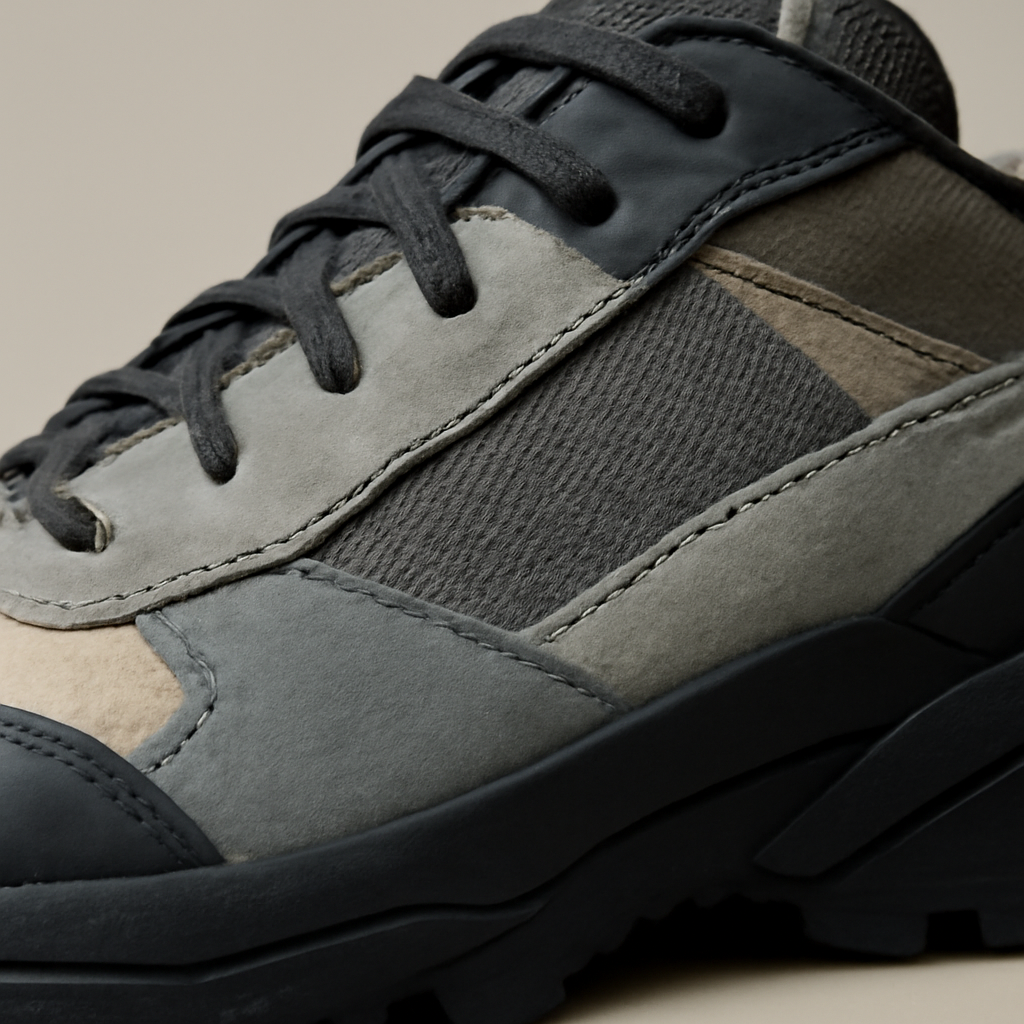
There is a version of this decision that would have been easier and more profitable in the short term: chase the sneaker-of-the-moment cycle, smooth the gradients into something more palatable, let the shoe photograph better than it performs. Salomon hasn't done that. The gradient stays. The rock-plate seam stays visible along the outsole, exactly where it was before anyone thought to photograph it on purpose.



