

For most of a week before her first Paris runway, Lily Brant walked back and forth on a treadmill in heels, alone, the belt moving under her at a speed no actual runway would ever quite match. She is twenty. The show she was readying for was Alaïa's — the house her mother, Stephanie Seymour, had been dressed by since she was roughly Lily's age now, and had, by her own account, taken a little advice from before the walk itself.
A treadmill rehearses the wrong thing, technically. It teaches a steady pace, a fixed direction, a belt that corrects for you if your stride drifts — none of which is what a runway actually demands, which is closer to walking confidently into a room full of people deciding, in real time, what they think of you. What a treadmill can rehearse is the only part that's actually yours to control beforehand: the shoe, the ankle, the thousand small adjustments a body makes to stop being afraid of four inches of heel. Everything else about the walk has to be invented live.
Her mother's version of that invention happened on a staircase, not a belt. Decades earlier, modeling for the same house at the Palladium club in New York, Seymour described the show's monumental set as so steep that "unless you had a death wish, nobody ever used that staircase" under ordinary circumstances. She went down it anyway, after watching Iman descend first with what Seymour called an elegant, twirling command of the room that set an impossible bar for whoever walked next. Seymour's own turn, she has said, felt like "trying to scale down the side of a pyramid in heels" — "a trauma and an honor," in the same breath, as though the two were never really in tension. Other designers had told Azzedine Alaïa she couldn't walk. His answer was shorter than the complaint: "But who cares? She has the best butt!" He kept booking her anyway, and kept being right to.
What gets inherited, in a story like this, is not a staircase or a treadmill — it's the fact that neither woman arrived at the walk already knowing how to do it. Seymour had to invent hers in front of a room with no net underneath. Brant had a treadmill belt to rehearse on, which is a kinder net but still no substitute for the room. A borrowed name gets you the invitation. It has never once gotten anybody down the runway; that part has to be re-learned, badly and privately, every single time, no matter whose daughter is doing it.
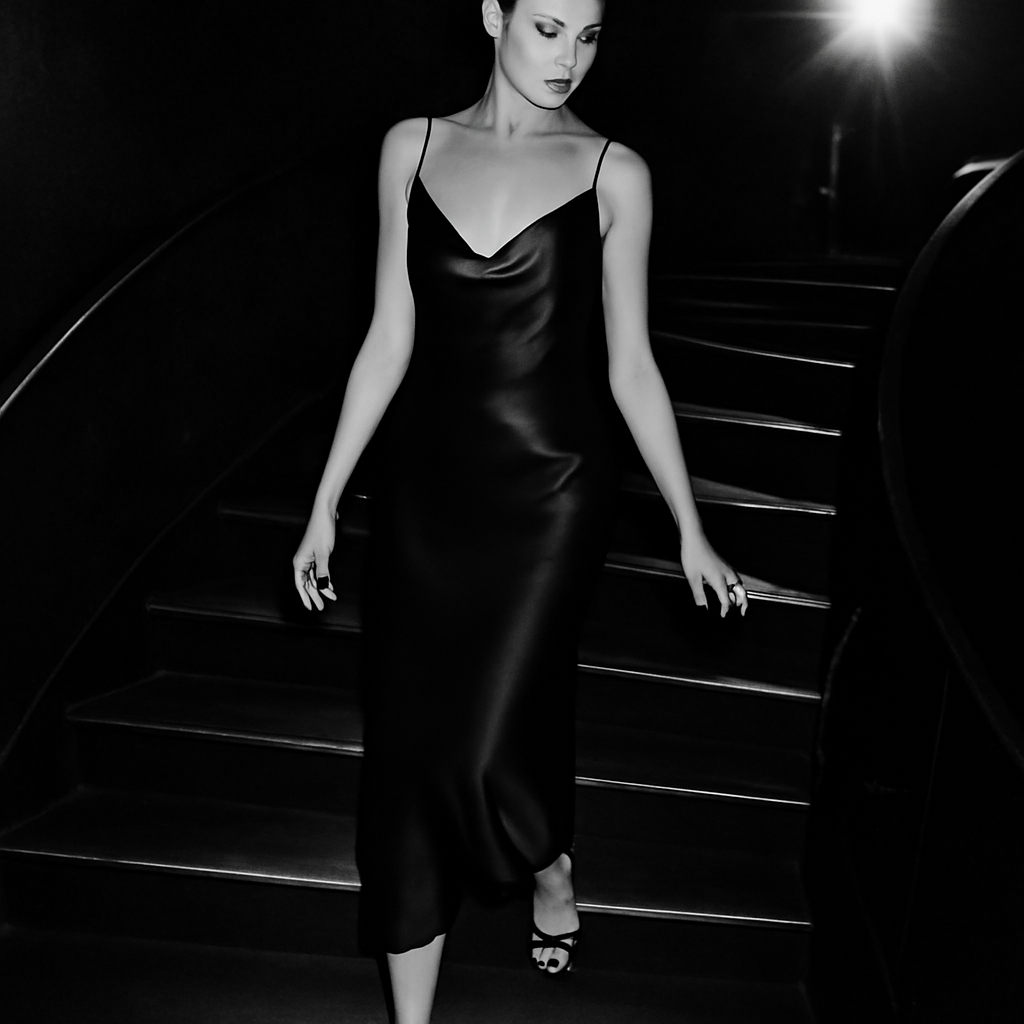
Azzedine Alaïa himself came to clothing by way of sculpture — trained at the Tunis Institute of Fine Arts before he ever touched a bolt of fabric, which is one way to explain why his dresses were always cut to reveal a body's actual structure rather than drape politely around it. He never lived to see Lily Brant's debut; the house he left behind is currently being run, in the absence of a creative director, mostly by its own atelier and its studio director, Boaz Eli. The spring collection that preceded Brant's walk was, by design, a quiet one — familiar silhouettes handled, as one review put it, with a noticeably lighter hand, a house choosing restraint over reinvention while it decides what comes next. A body still learning the floor it's standing on; a house doing much the same.
The treadmill belt, afterward, goes still. It doesn't remember the practicing. Lily Brant does.


