
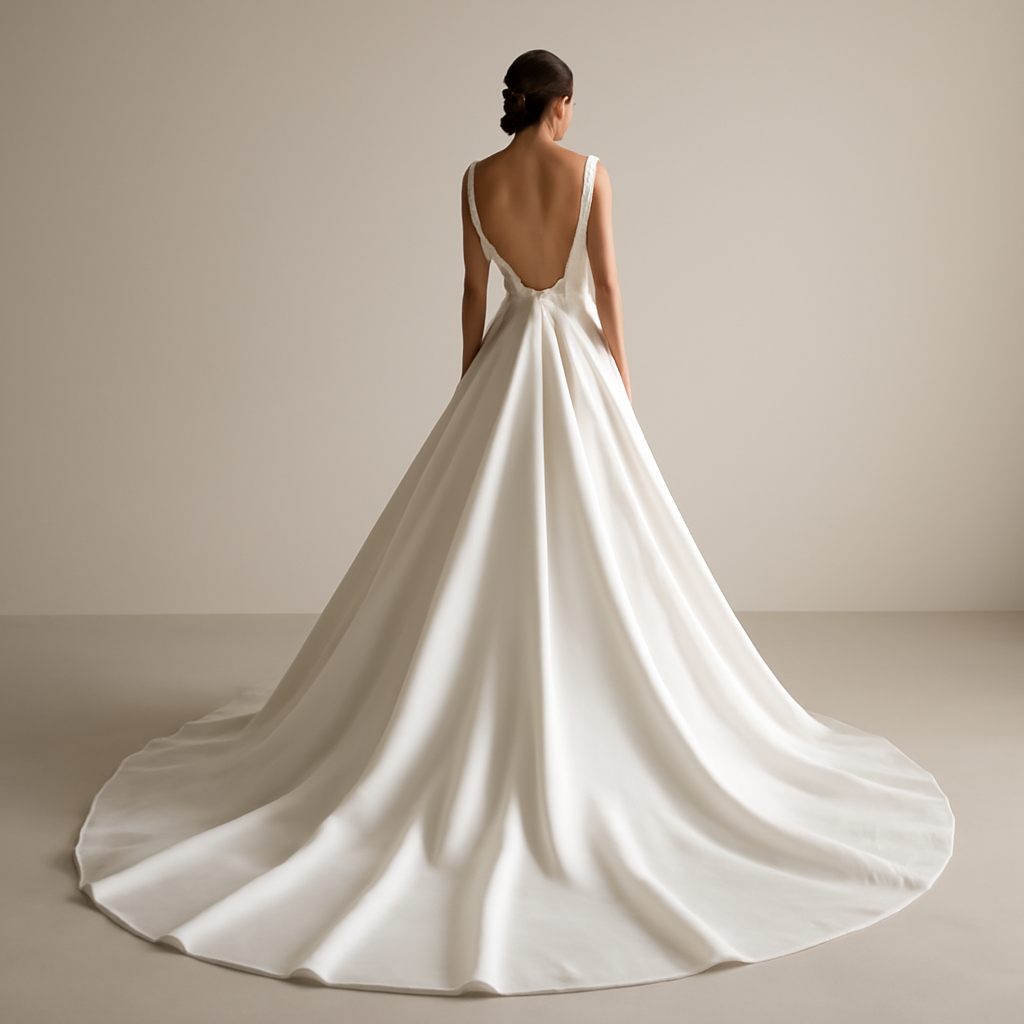
A Berta gown announces itself before it does anything else. The signature is consistent across two decades of collections: a back cut open nearly to the base of the spine, a train built to pool rather than trail, tulle and lace layered until the dress reads as an event rather than an outfit. It is not a quiet silhouette. It was designed, deliberately, to be the opposite of quiet — and it now defines a meaningful share of what "modern bridal" looks like worldwide, worn by Britney Spears and Priyanka Chopra and stocked from Saks Fifth Avenue to bridal salons in nearly two dozen countries.
Berta Balilti built that silhouette from Ashdod, a port city in southern Israel, where her studio still operates as the brand's only design headquarters. She arrived there as a small child, not by choice. Her family left Cairo when she was three, part of the decades-long exodus of Egyptian Jews under Gamal Abdel Nasser's government, which had declared Jews enemies of the state; those departing were permitted one suitcase and the equivalent of twenty-five dollars each, and Balilti's family lost a working jewelry business her maternal grandfather had built. Her father, after settling in Israel, was injured on a boat and could no longer work steadily. It was not a childhood arranged around abundance.

She trained at Shenkar College of Engineering and Design in Tel Aviv, then spent her early career as a seamstress and junior designer at a ready-to-wear house, sketching and sewing wedding gowns at home in the evenings — a second, unpaid apprenticeship running alongside the first. In 1995 she opened La Belle, a small bridal salon where she worked as the sole designer. It took nine more years, and a larger facility, before the label became Berta Bridal in 2004. Growth followed less like a rocket and more like an accretion: fifteen retailers within a year, thirty within two, her son-in-law joining in 2012 to build out an international side that now spans roughly sixty stockists.
None of this is offered as an explanation for the work, and it shouldn't be read as one — the connection between a hard childhood and a maximalist eye is a real observation, not a law, and plenty of designers have gone the opposite direction toward austerity after deprivation. Still: a woman whose family measured its exit from a country in a single suitcase and a fixed sum of cash spent her career designing garments defined by excess of fabric, excess of train length, excess of exposed skin at the back — abundance not as forgetting where she came from, but as one very particular way of answering it.
"My parents raised me to believe I can be anything I want," she has said of the decision to chase design in the first place, "so I just went ahead and chased my dream." The train still pools instead of trailing. The back still opens nearly to the spine. Most of the women wearing it have no idea any of it started with one suitcase and twenty-five dollars.



