
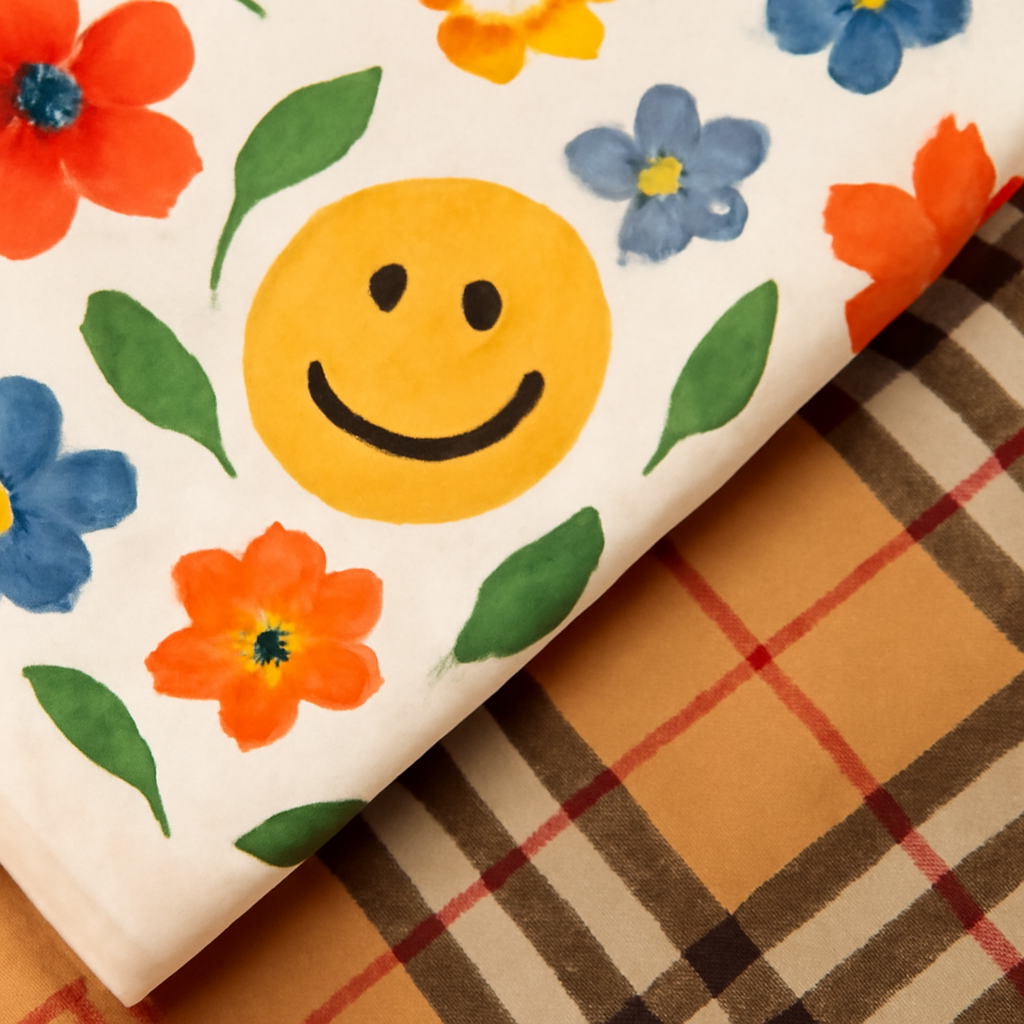
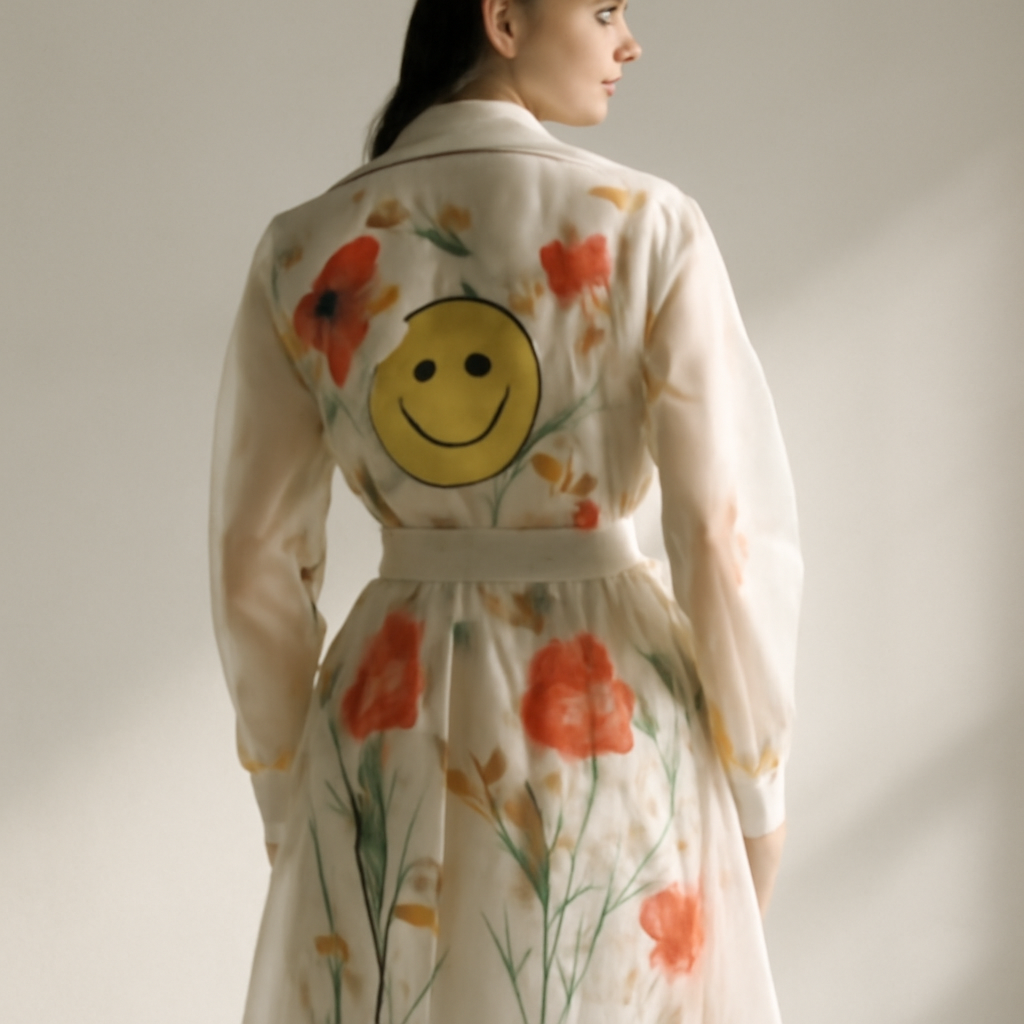
Celia Birtwell kept a folder of faces nobody had asked for. Round, bright, unmistakably hand-drawn — a bouquet of grinning circles she'd sketched some twenty years earlier and filed away when no collection came looking for them. They surfaced this month on the backs of Burberry trench coats: ruched at the collar, cut in slinky silk taffeta with puffball hems, scattered among chunky hand-drawn checks and blowsy botanical prints of mimosas and rosebuds. One model carried an embroidered umbrella. Nothing about the faces had been smoothed for the occasion. They still looked drawn, not designed.
The question worth sitting with is why a house built on the most machine-precise pattern in fashion — a check trademarked, licensed, and reproduced with almost pharmaceutical consistency since the 1920s — needed someone else's old sketchbook to feel finished. Thomas Burberry opened his outfitting shop in Basingstoke in 1856 chasing a specific, unglamorous problem: the rubberized mackintosh raincoat of his era was heavy and airless, so he wove a tighter, water-resistant cotton twill he patented as gabardine, and built an empire on explorers and aviators who needed to stay dry without suffocating. The check came decades later, an internal lining before it was ever a logo. By the time Daniel Lee inherited the house, the pattern had long since stopped being a piece of cloth and become a piece of corporate identity — reliable, reproducible, and, on its own, a little cold.
Birtwell's contribution wasn't a new print so much as a visible hand. "The check is so dominant and so brilliant that at first I thought: what can I do here?" she said of facing down the house's signature. What she did was refuse to compete with it directly — she painted a looser, less structured version of the check itself, then let her own vocabulary run alongside it: the psychedelic vines and blowsy florals that made her name in the 1960s, plus faces that had been sitting in a drawer since nobody in particular asked for them. The house's current designer, Daniel Lee — a mechanic's son from Bradford who trained at Central Saint Martins and had already made Bottega Veneta's waitlisted handbags the industry's most-copied accessory before Burberry hired him in 2022 — was blunt about what a logo can't do by itself: "She made the check more human. If you are buying a luxury product it's not a necessity, it's an emotional purchase, so it needs to feel human."
There's a precedent for this exact division of labor, and it belongs to Birtwell herself. In the 1960s and early '70s she designed textiles for Ossie Clark, the London tailor she later married, while he handled the cutting and construction; his skill with a bias seam and her sense of pattern produced some of the era's most quietly radical clothes — garments that looked romantic until you noticed how precisely they were engineered underneath. "He was a genius," she said of Clark years later, "better than Yves Saint Laurent." Sixty years on, the arrangement has simply changed addresses: a different tailor supplying the structure, a different house supplying the scale, and Birtwell still the one deciding what a fabric is allowed to say once the cutting is done.
What the collaboration clarifies, seen this way, is that heritage doesn't automatically produce warmth; it produces consistency, which is a different thing and occasionally its opposite. Burberry's most reliable asset — the pattern nobody can mistake for another house's — is also the part of the brand least able to carry a private joke or an unfinished thought. It took an outside hand, and specifically a hand old enough to have been doing this since before the check was licensed the way it is now, to put something unresolved back into the cloth. The faces are still in the collection, grinning the same grin they had in the folder twenty years ago, riding down a runway on a coat that took two decades to admit it needed them.



