
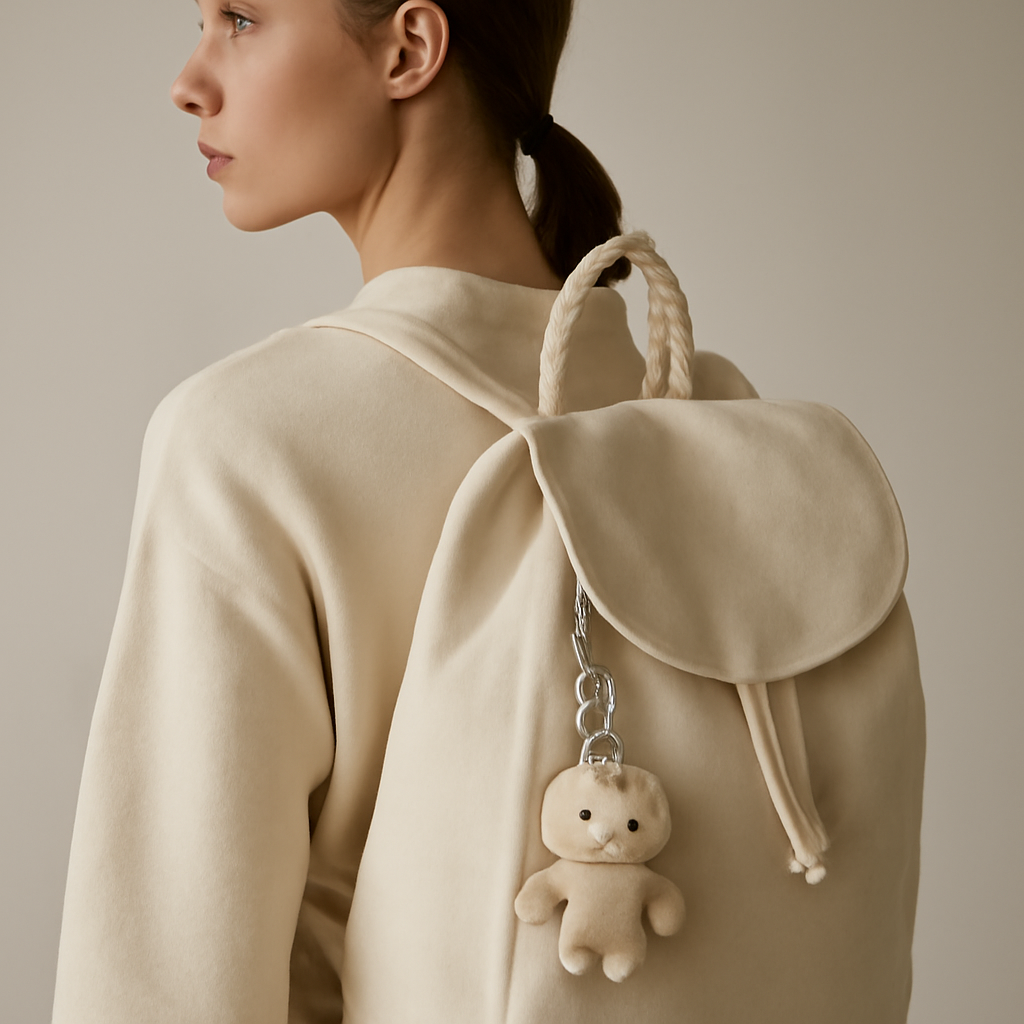
The backpack that opens the collaboration between eYe Junya Watanabe Man and Mammut carries almost nothing extra: a single rope-loop handle, a canvas body cut close to the frame, and a small mascot clipped to the strap with a real climbing carabiner — the kind rated to arrest a falling body on a rock face, now holding a toy. Six jackets follow the same logic. One, cut from Ventile cotton, has a hood that unclips entirely. Another quilts eiderdown into patchwork panels the way Watanabe has quilted denim and tweed for three decades. Nothing about the garments announces itself as costume. Nothing about them, either, has any real reason to leave the city.
Mammut did not begin as a fashion house or even an outdoor one. The company traces to 1862, a rope-maker named Kaspar Tanner working in the Swiss village of Dintikon, supplying cord for farms rather than summits. It didn't take the Mammut name until 1952, the year it began treating rope as an alpine safety discipline rather than an agricultural one — a shift that produced, within a few years, one of the first nylon glacier ropes and, later, an avalanche transceiver built for the Swiss Army. What the brand sells, in other words, is not an aesthetic. It's the accumulated weight of a hundred and sixty years spent keeping people alive at altitude.
What Watanabe borrows from that history is not the function but the rhetoric — the visual promise that whoever wears the jacket has done, or might do, something requiring rescue equipment. It's a promise almost no wearer will test. His own reputation was built on a related sleight: pattern-cutting that treats function as raw material rather than destination, applied since his 1992 debut under his own name to biker leather, tailoring, and camouflage with equal detachment, each stripped of its original claim on the body and reassembled as argument. The alpine capsule isn't a departure from that method. It's closer to its most literal test case: gear built to keep someone alive handed to a designer whose real interest is in what a garment says rather than what it does.
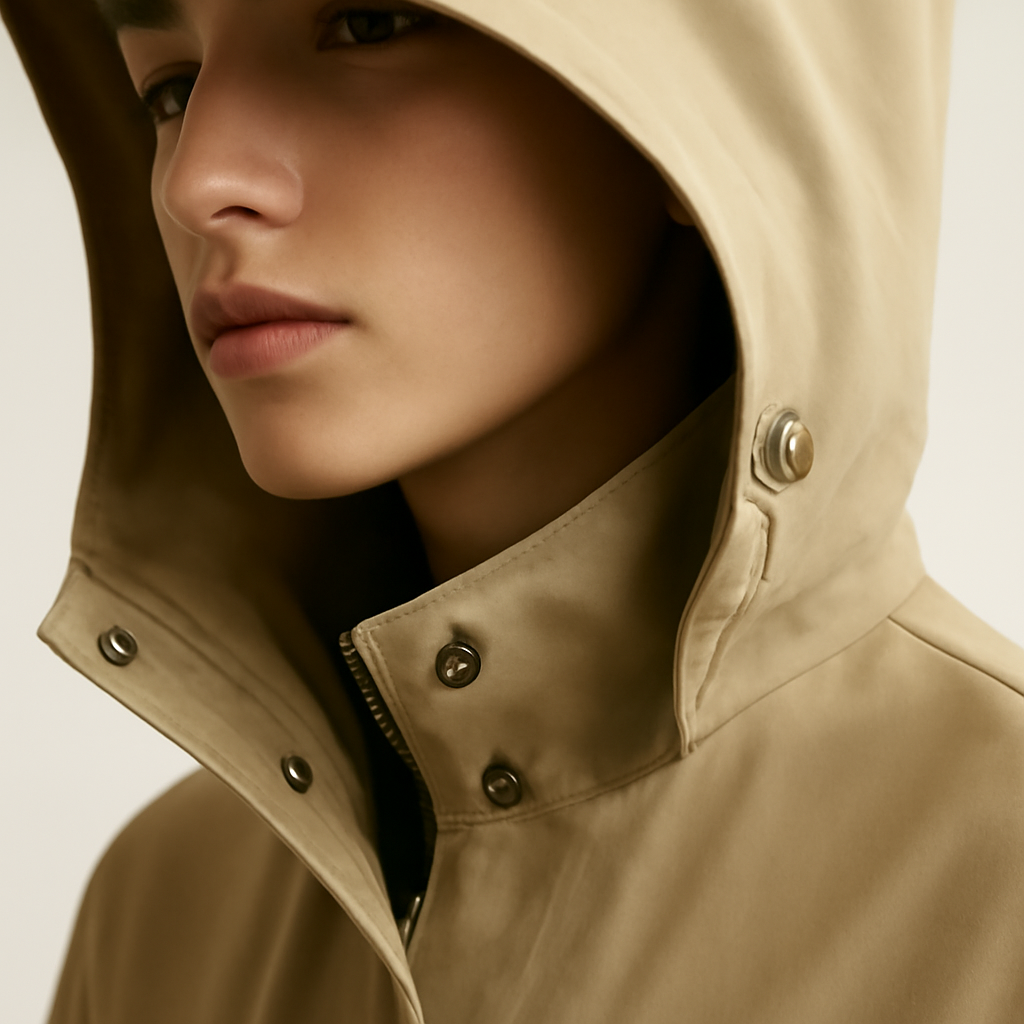
Watanabe's own description of the project doesn't hide this gap so much as name it plainly. "This season," he said of the capsule, "I wanted to create some pieces that combine the craftsmanship and elegance of eYe JUNYA WATANABE MAN with the genuine alpine expertise and technical innovation of Mammut." Craftsmanship and elegance on one side, genuine expertise on the other — two different registers, held together by a zipper rather than resolved into one. The campaign built around the collection makes the same point through a different medium. Shot with the CGI artist Blocki, its images set escalators and elevator banks inside alpine landscapes — a glacier crossed by a moving staircase, a summit reached by lift. It reads as a joke, but a precise one. The capsule's real terrain was never the mountain. It was always the entryway of a building.
There is a longer habit behind this particular joke, of course — city dwellers borrowing the vocabulary of wilderness survival without ever intending to survive anything, a trade that's kept mountaineering brands solvent in decades with fewer mountaineers than shoppers. What the Mammut collaboration adds isn't the trade itself but a designer willing to make its terms visible instead of pretending the jacket was always meant for a trailhead. The rope-loop handle on the backpack is a real rope loop, load-rated, tied the way a climber would tie it. It will most likely spend its working life on a shoulder in a subway car, past a turnstile, up a flight of stairs to an apartment door. The carabiner holds exactly as it was built to. It has simply never been asked to hold very much.



