
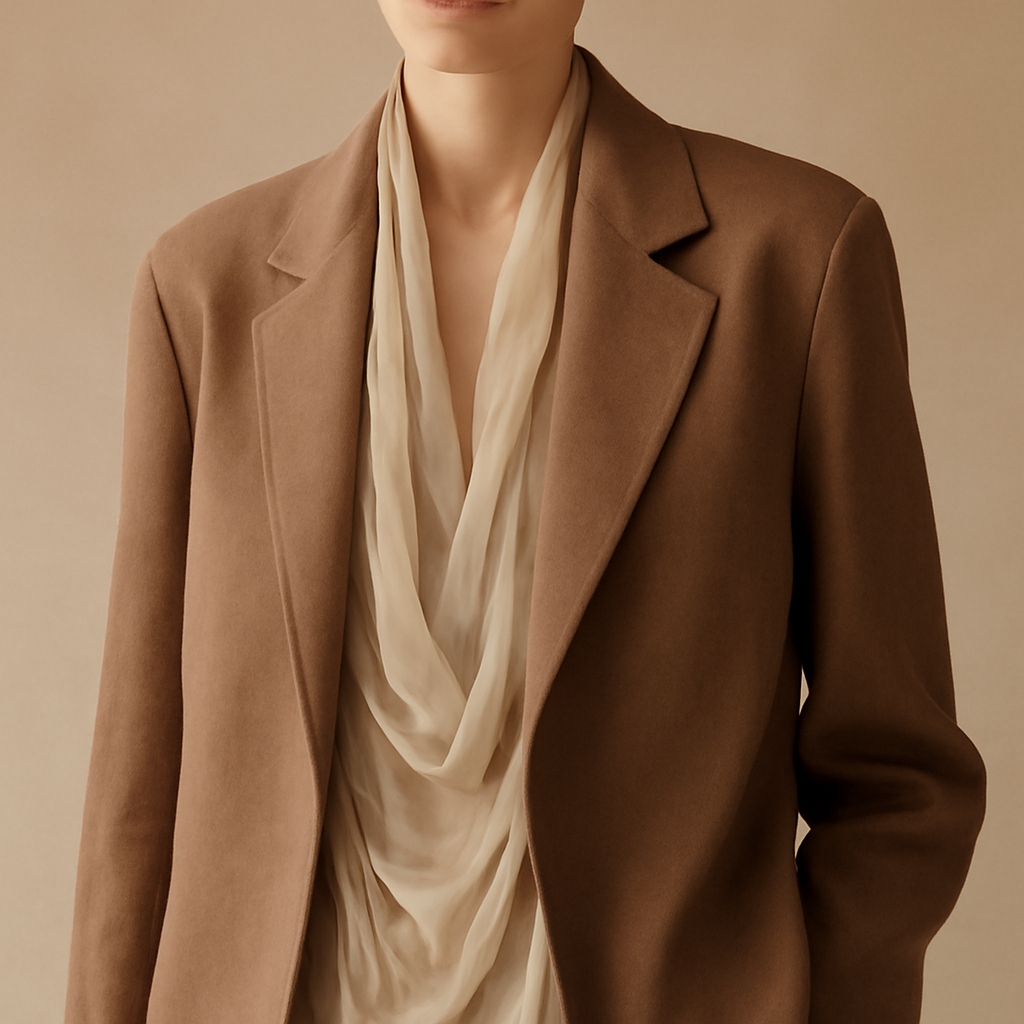
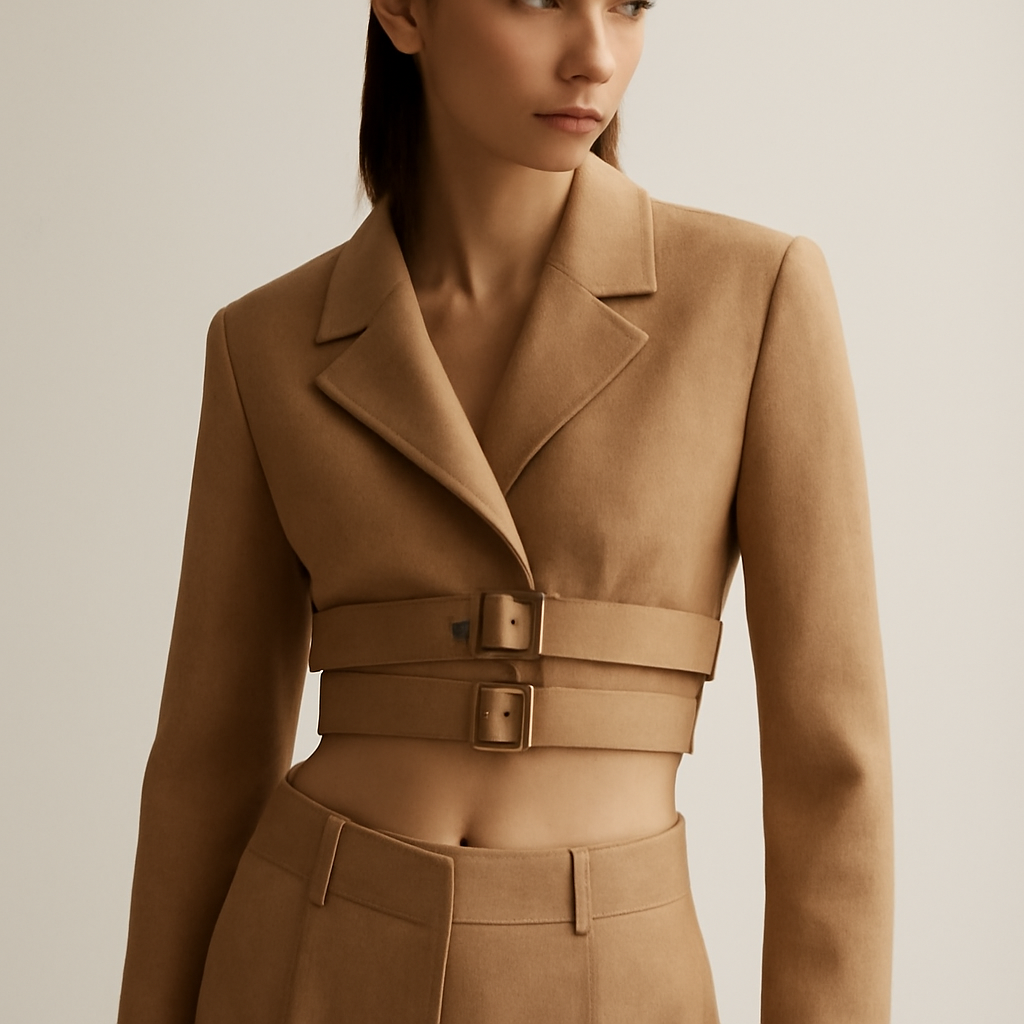
The shoulder came first, and it came undone. Where the house's own 1940s archive holds sharp, decisive tailoring, Maximilian Davis let the line drop and soften for spring, the structure pared back until a jacket's shoulder fell the way linen falls after real heat rather than a fitting room. Belts came doubled and raised high across the ribcage instead of cinched at the waist. Patch pockets were sewn on for shape rather than use. Nothing about the collection read as costume. It read like clothing already lived in by someone who had somewhere else to be.
That instinct — clothes built for use before they're built for looking at — runs under everything Davis has made since he was a child in Manchester, watching his grandmother work an industrial sewing machine and, later, apprenticing with the tailor who cut his own mother's clothes. He studied at the London College of Fashion, worked under Grace Wales Bonner, and by 2020 had a label of his own built on the specific pageantry of Trinidadian Carnival, the culture of both his parents. Two years later, Ferragamo — a Florentine house built on Salvatore Ferragamo's own shoemaking precision — made him its creative director: a designer known for dressing bodies in motion, now custodian of a house built on standing still and being measured.
For spring, Davis chose to root the collection in a single reference: Lee Miller, the photographer born in Poughkeepsie, New York, who spent the back half of the 1920s as one of Vogue's most photographed models before turning the camera around. She trained in Paris under Man Ray, with whom she rediscovered solarization, the darkroom accident that turns a print's tones inside out. In 1934 she married the Egyptian businessman Aziz Eloui Bey and moved to Cairo — a marriage that left her, by her own account, restless — but Egypt gave her light, ruins, and a desert palette that shows up unmistakably in the images she made there, including Portrait of Space, a work absent of any human figure at all. Davis borrowed that palette directly: sand, rust, the specific ochre of a wall at midday. He borrowed her military-adjacent uniform shapes too, but only after loosening them, the way a person softens a family story in the retelling without losing what happened.
Miller went on to photograph the liberation of Buchenwald and Dachau for Vogue, and, on the day Hitler died, bathed in his abandoned apartment's tub with the mud of the camps still on her boots on the bathmat — a photograph as much about what a body carries out of a place as what it carries into one. Davis's collection doesn't reach for that darkness, and it shouldn't; a runway is not the place to metabolize a death camp. What it does reach for, correctly, is her refusal to stay only on one side of the lens. A woman who had spent a decade being arranged by other people's cameras spent the second half of her life deciding what got photographed and how. Davis's own tailoring makes a similar argument in miniature: a shoulder that no longer holds a shape for the sake of being seen holding it.
The show's final look returned to where it started — a jacket, cropped, the shoulder dropped a half-inch further than fashion currently agrees is correct, worn open over nothing ornamental at all.



