
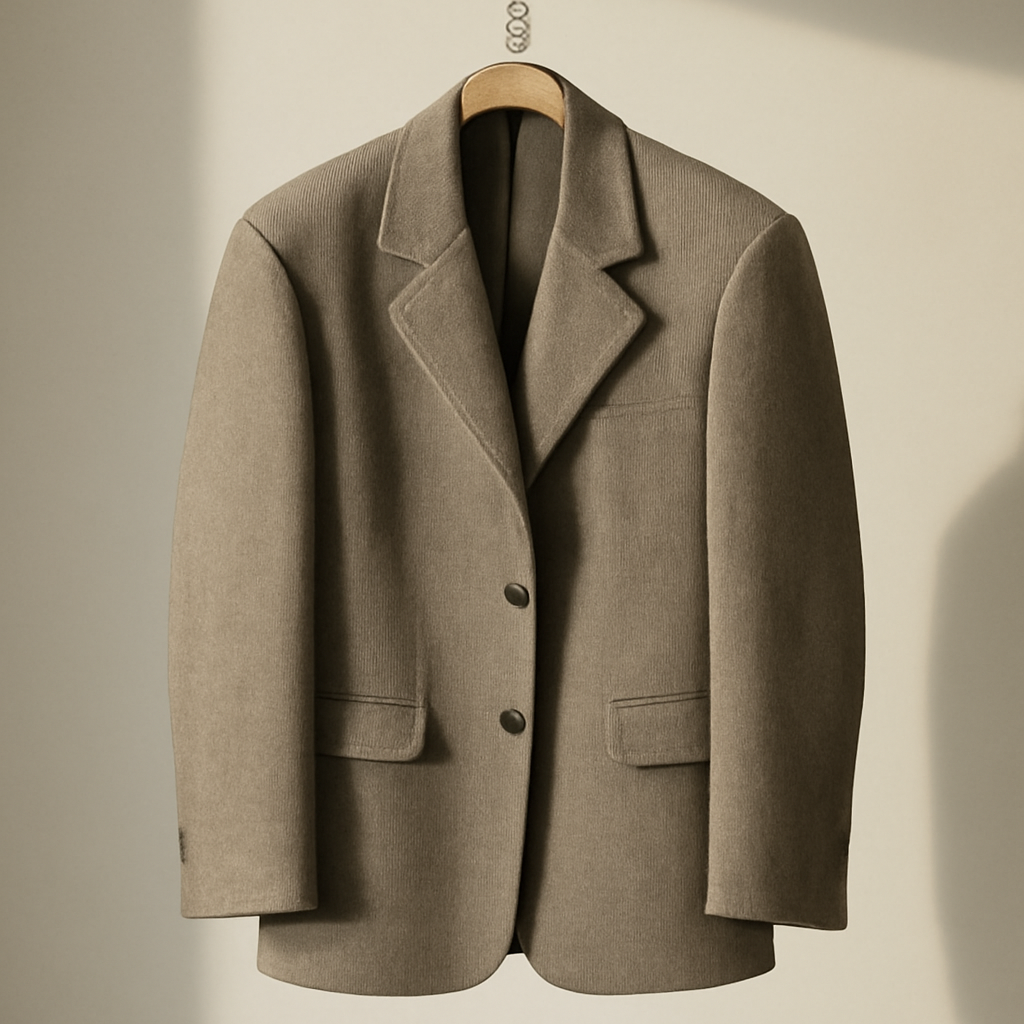
A suit that doesn't fit is usually a tailor's failure. On Hed Mayner's runway, it's the entire proposition: shoulders extended a fist's width past where a seam should sit, sleeves that swallow the hand, a lapel wide enough to double as its own separate garment. The trousers pool at the ankle. The jacket hangs the way a jacket hangs on a hook, not the way it hangs on a body. Seen once, it reads as exaggeration for its own sake, one more oversized-tailoring trend note. Seen with its actual reference in mind, it reads as something closer to memory than proportion.
Mayner grew up in Amuka, a small community in Israel's Galilee that doubles as a pilgrimage site for Hasidic Jews, and what shaped his eye wasn't a fashion archive but the Haredi boys he watched around the village as a child. The suits those boys wore were routinely handed down from one brother to the next, which meant a jacket was rarely cut to fit the child wearing it that year; it was already sized, deliberately, for the child who'd grow into it later, wrinkles, folds, and the evidence of a previous owner left in rather than pressed out. "It's traditional menswear items blown out of proportion, but there's an attitude in this incorrectly worn piece," Mayner has said of the effect he chases. The suit isn't wrong. It's early.
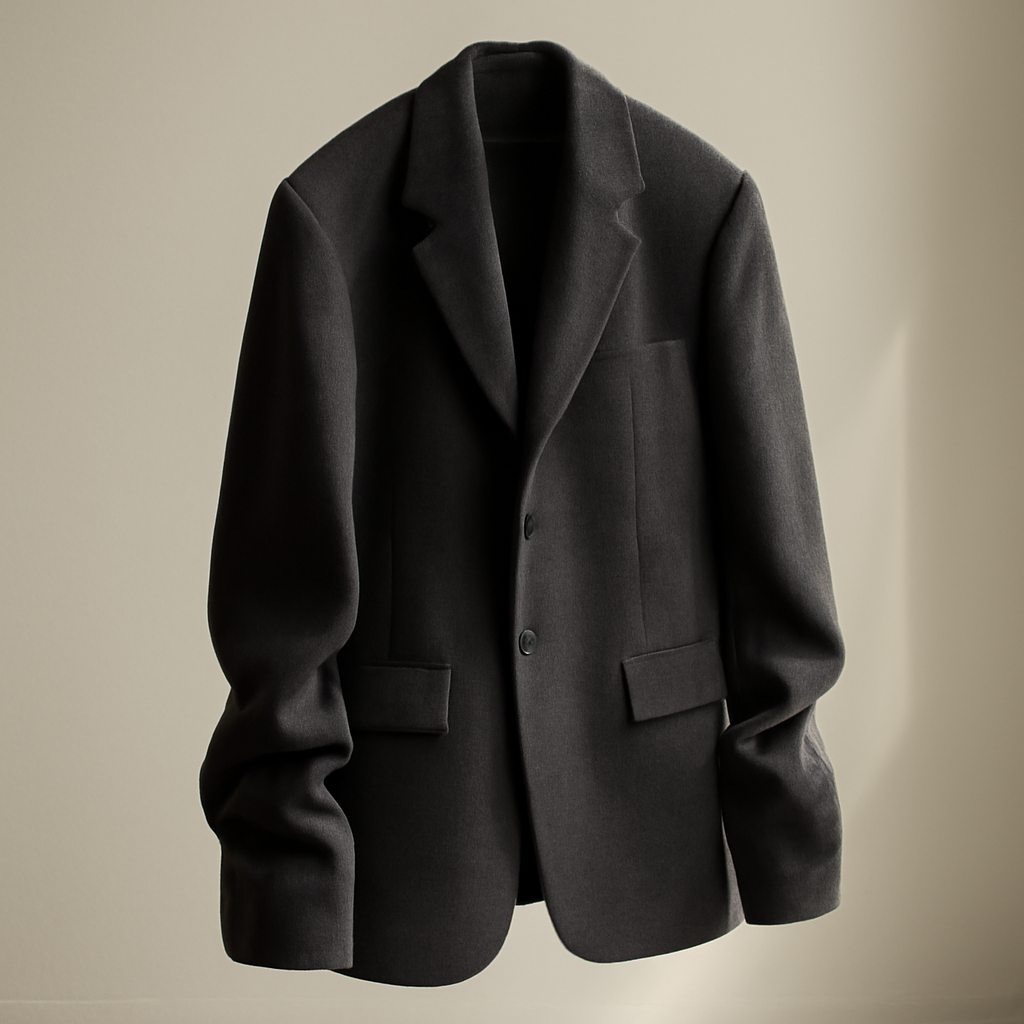
That idea — clothing built with its next wearer already factored into the pattern — has real precedent outside a single village. Military tailoring, another of Mayner's stated references, works on the same logic at institutional scale: uniforms are cut in ranges and reissued down a chain of ranks, a coat outliving any one soldier's tour of duty. But an army's version of hand-me-down dress is administrative, sized by quartermaster's chart. What a Haredi household does with a growing boy's suit is smaller and more intimate, argued at the level of one family rather than one institution: the crease a father's jacket picked up at the elbow doesn't get steamed out before it goes to his son, because the crease isn't a flaw. It's information about who wore the jacket last, and how.
Fashion has its own tradition of deliberate wrongness — padded, asymmetrical silhouettes built to interrupt a season's prevailing shape, or garments reconstructed so the seams of a previous life stay visible on the outside rather than hidden in the lining. Both treat imperfection as information the way Mayner does. But that lineage usually comes from an instinct to disrupt fashion's own conventions, deliberately, from outside a body's actual history. Mayner's wrongness isn't an intervention. It's a memory of clothes he actually watched people wear, on a specific hillside, for reasons that had nothing to do with fashion at all.
Mayner has spent a decade turning that memory into a menswear label of his own — the first Israeli designer on Paris Fashion Week's official calendar, a run to the final round of the LVMH Prize in 2019. None of that changes what the tailoring is actually doing on a body on a runway in Paris, a continent and a wardrobe away from Amuka: refusing to resolve into a fit, on purpose, the way a story refuses to resolve into a moral. A jacket built too big isn't a jacket that failed. It's a jacket that hasn't finished being worn yet.



