
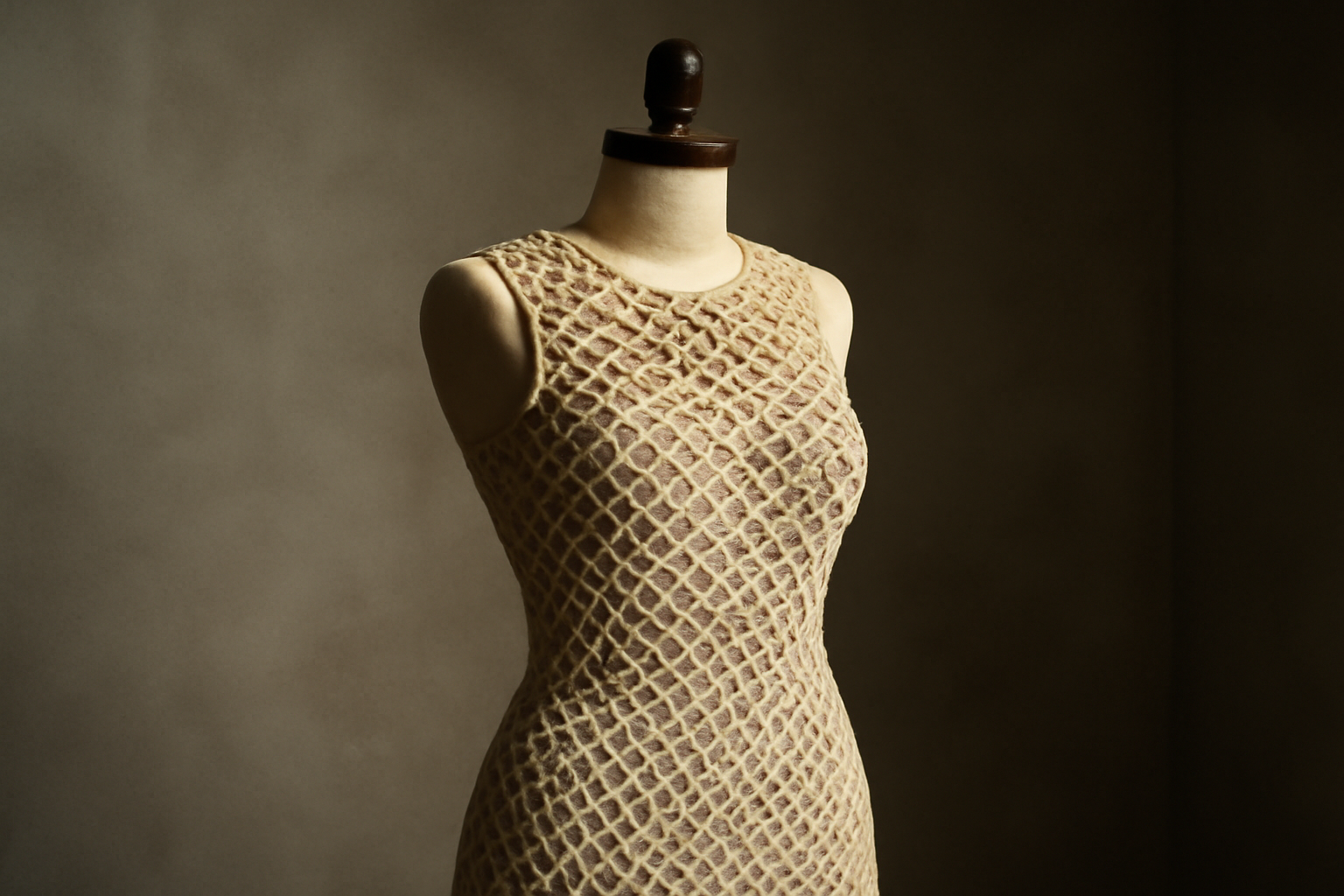
In her final year of design school, Danit Peleg ran a desktop 3D printer for most of a year, overnight in her apartment, waiting for pieces of clothing to finish printing the way another student might wait for laundry. There was no factory involved, and no industrial machine — the flexible plastic filament she used, called Filaflex, comes off the same size printer sold to hobbyists building small model parts. What came off the print bed didn't look like fabric so much as a fine plastic mesh, rubbery enough to bend at the elbow and knee, sturdy enough to run through a dishwasher. She printed five full outfits this way, including the shoes, calling the collection Liberty Leading the People.
The choice to use a home printer rather than an industrial one wasn't a budget compromise — industrial 3D printing already existed and was, if anything, easier to control. It was the actual premise of the project: proving a garment could be manufactured entirely outside a factory, on the same machine an amateur might use to print a phone case, by anyone with the file and the patience to wait.
The material comes off a home printer looking more like a fine plastic net than cloth.
The design school was Shenkar College, outside Tel Aviv — a school split across engineering, design, and art faculties under one roof rather than three separate departments, training that shows up in how Peleg still talks about clothing: less like sketching, more like a specification problem. She didn't win her class's prize for best final project. The collection went viral anyway, picked up by the New York Times and the Wall Street Journal within weeks, and by that September Tyra Banks had flown her to Los Angeles for a six-minute segment on the talk show FABLife, an interview and runway show built around clothes that had never touched a sewing machine.
The idea kept traveling to places sewing machines don't usually reach. In 2016, Paralympian Amy Purdy wore Peleg's 3D-printed Birth of Venus dress at the Rio opening ceremony, a garment built to move with a body that a standard pattern-drafting process — designed around an assumed range of motion — would have had to modify rather than originate for. By 2020 Peleg had removed another layer entirely: her NFT store didn't ship a finished garment. It sold a digital file and a set of instructions, so that the person paying for the design was also the one who'd eventually print it, at home, the same way she had. A five-piece Nouns DAO commission followed, funded for $140,000 and debuted digitally at Metaverse Fashion Week before it ever existed as a physical object.
The dress was built for a body a standard pattern would have needed to modify, not one it was drafted for.
She's since gone a step further than the printer. The software she's building now takes a design prompt and an ordinary sewing pattern and converts both into a printable textile structure directly — no draping, no muslin mockup, the fitting process compressed into a file. She's begun offering the tool to sportswear and luxury brands whose whole production model her original project was built to sidestep.
The file, not the fabric, is where she says the actual design work happens now.
It's a strange kind of ambition: rather than building a house that grows to depend on skilled hands, she keeps figuring out how to take work another hand was doing and hand it to a machine instead — and eventually to the customer's own printer. The dress Amy Purdy wore in Rio was, in the end, still just a file most people never saw. What Peleg has spent a decade proving is that the file was always the actual garment; the plastic was only ever the proof it could be worn.



