
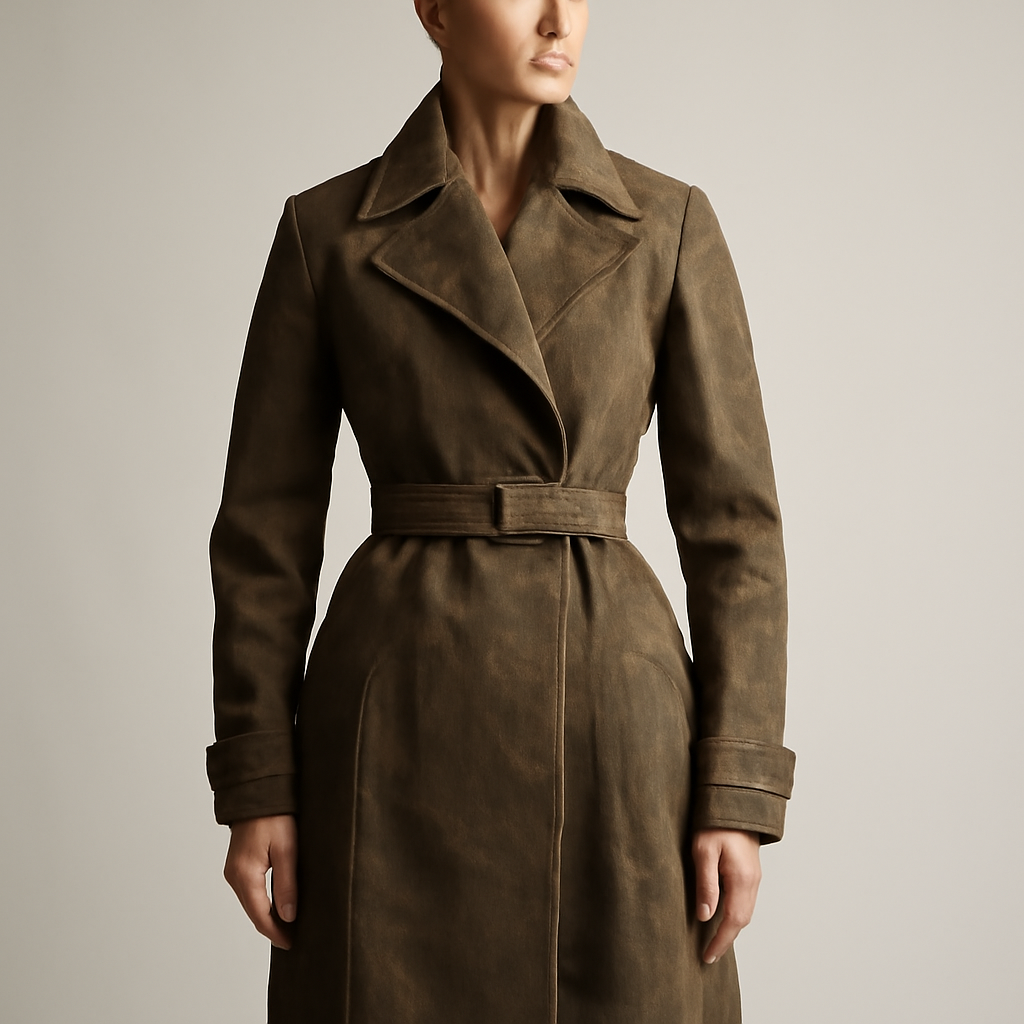
The trench coat in Hed Mayner's debut Paris collection is not built from wool gabardine or coated cotton, the materials a trench has used since the First World War. It is cut from military tent canvas — stiff, waxed, meant to shed rain over a sleeping body in a field rather than drape across a shoulder. The seams sit where a tent's seams would sit: reinforced, visible, doing structural work rather than hiding it. Cut this way, the coat holds its shape whether or not anyone is standing inside it, the way a tent does.
A trench is one of tailoring's most standardized garments — the storm flap, the belt, the epaulettes have barely changed in a century, precisely because a uniform depends on not changing. Mayner's version keeps the vocabulary intact and refuses only the fabric that makes it comfortable to wear. The effect isn't rebellion so much as literalism: if a coat this rigid is what the silhouette has always promised, here is what that promise looks like kept, in the actual material a promise like that would require.
Mayner was born in Amuka, a village of roughly forty families in the Upper Galilee that also happens to be a pilgrimage site for Orthodox and Hasidic Jews visiting the tomb of a first-century sage. His mother paints; his father works metal. He started designing at sixteen, after a neighbor returned from years in Japan with a collection of kimonos that Mayner spent months studying for how the fabric was folded and layered rather than cut to a body's exact shape. At twenty-two he enrolled in the fashion and jewelry department at Bezalel Academy in Jerusalem, graduating with honors in 2012 before continuing at the Institut Français de la Mode in Paris. He founded his label in Tel Aviv in 2015 and became, in 2017, the first Israeli designer to show on Paris Fashion Week's official menswear calendar.
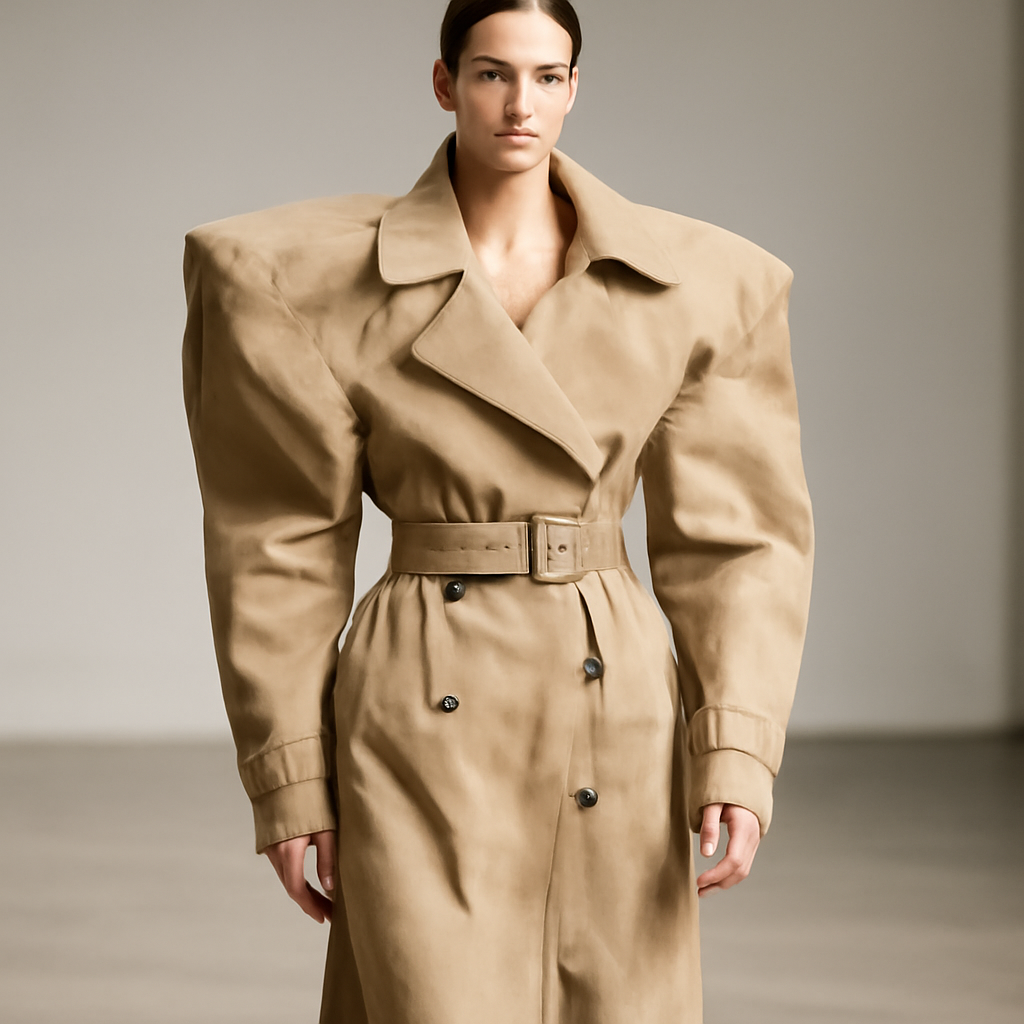
That same debut collection paired the tent-canvas trench with a sleeveless top cut from tallit fabric — the material used for a Jewish prayer shawl — worn as beachwear, alongside djellabas, PVC jackets, and ordinary jeans. Mayner has said the idea of uniform first became material to him as a student in Jerusalem, watching a city organized around two of them running at once: the army and the synagogue, each claiming the same unquestioned authority over what a body wears and when. Between Amuka's pilgrims and his own national service, he'd had unusually literal access to both before he'd designed anything at all.
A uniform, military or religious, works by removing the question of what to wear — the individual disappears into a code decided elsewhere, in advance, for reasons that don't require the wearer's consent. Distorting that code, the way Mayner does with an oversized shoulder or an off-grain hem, doesn't argue against the uniform's authority so much as insist a body is still underneath it, refusing to fully vanish into the cut. The tent canvas performs the same trick by other means: a fabric engineered to survive weather regardless of who's inside it, remade into something that only means anything with one specific person wearing it.
Nothing about the trench has softened by the time it reaches the runway. The canvas still holds its shape when set down on a chair, still creases the way a tent wall creases when the wind changes. It just isn't a tent anymore. It's a coat somebody has to actually stand inside.



