
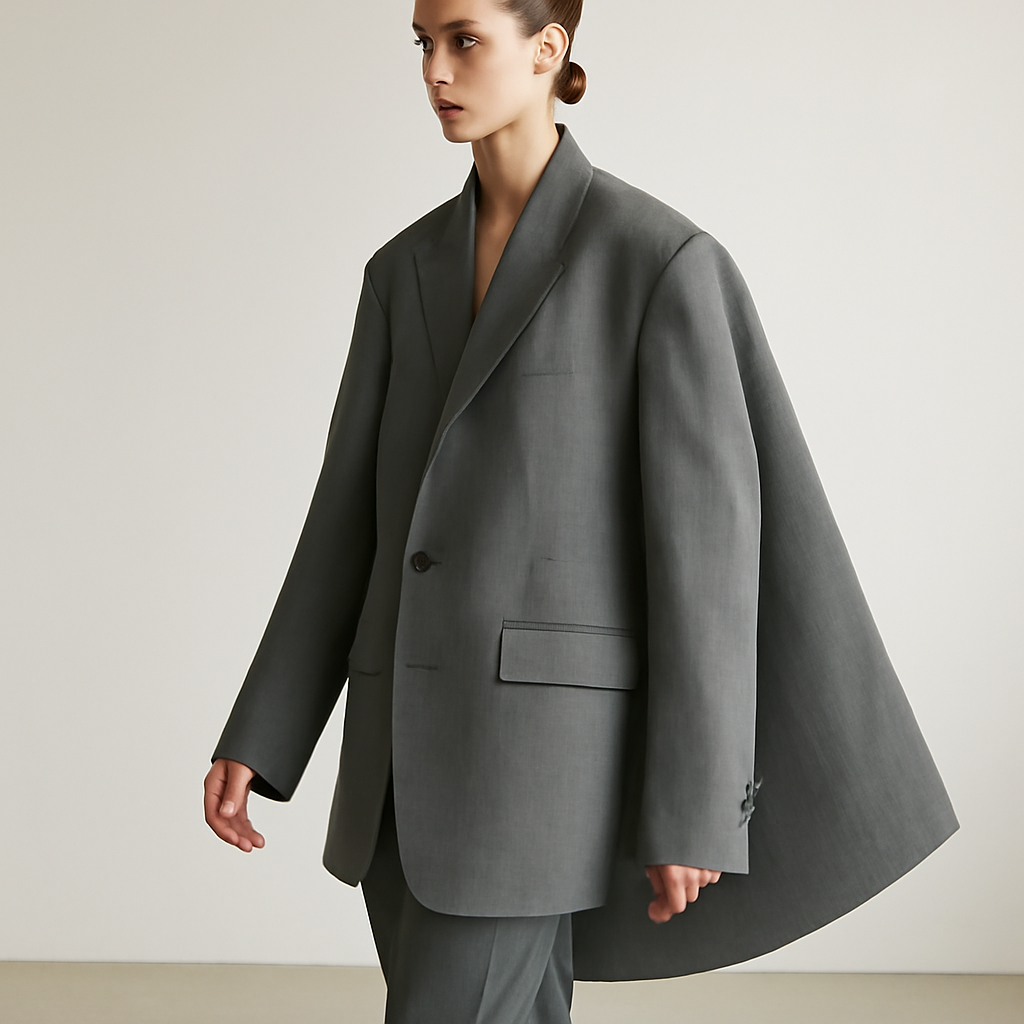
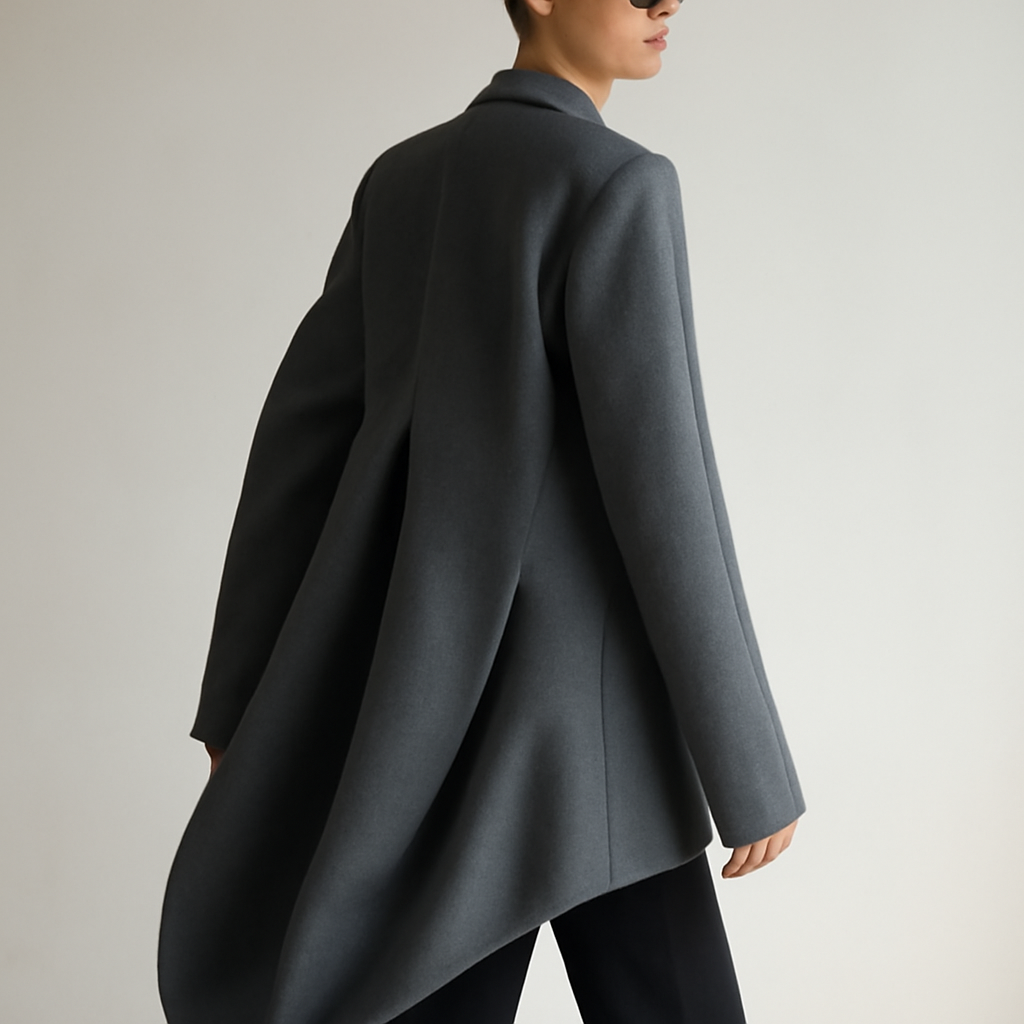
A jacket by Hed Mayner fits its wearer's chest the way a jacket is supposed to, and then keeps going: the back panel cut a size or two larger than the front, the sleeves ending somewhere past where the hands begin, the whole garment listing gently backward as if it belonged, originally, to someone slightly bigger. Mayner calls it, plainly, the falling-backwards jacket. He has been refining the same asymmetry — front narrow, back wide, "the narrow refers to the wide," as he's put it — for close to a decade, and it still reads on a runway as a mistake worth pointing at, not a mistake worth fixing.
The mistake has a source, and Mayner has never hidden it. He grew up in Amuka, a small village of roughly forty families in Israel's Galilee, near a site that draws a steady traffic of Orthodox and Hasidic pilgrims; his mother paints, his father works metal. Watching Haredi men in the surrounding communities wear tailoring — dark suits, white shirts, hand-me-downs passed from an older relative to a younger one without much concern for a precise fit — gave him a model of dressing that had nothing to do with status and everything to do with a kind of unbothered dignity. "The old Jewish tailoring is more about wrapping the body rather than shaping it," he's said, and separately: "What I like is the way the religious people wear their tailoring… there was nothing saying their status, if they were rich or poor, but it was still very dignified and beautiful." A suit worn a size too big, on a shoulder it wasn't cut for, still read to him as formal. That observation — dignity surviving an imperfect fit — became the whole premise of his label.
He studied fashion and jewelry at Bezalel Academy in Jerusalem, graduating with honors in 2012, then continued at the Institut Français de la Mode in Paris before founding his own line in Tel Aviv in 2015, working today from a studio near the city's central bus station. Two years later he became the first Israeli designer to show on the official Paris Fashion Week men's calendar — a fact he treats less as a triumph over circumstance than as evidence of how little fashion history existed in Israel to react against or repeat. That absence, he's suggested, was freeing rather than limiting: "there's nothing really" in the way, so a Galilee village's tailoring habits could stand in Paris without translation and be read on their own terms.

What the decade of collections since has mostly done is keep testing how far the wrapping can go before it stops reading as tailoring at all — oversized proportions blown out further each season, a two-year run directing creative direction at Reebok that let the same logic loose on sportswear, a guest slot at Pitti Uomo in Florence for his fall 2026 menswear. Through all of it the reference point hasn't moved: a suit that fits like it was inherited, on a body it wasn't cut for, worn with the same unconcern he first noticed among the men near Amuka. The oversized proportion, he's said, "gives a sense of strength and vulnerability at the same time" — the same jacket, on every runway since, still built for somebody else's shoulders, still worn without apology.



