
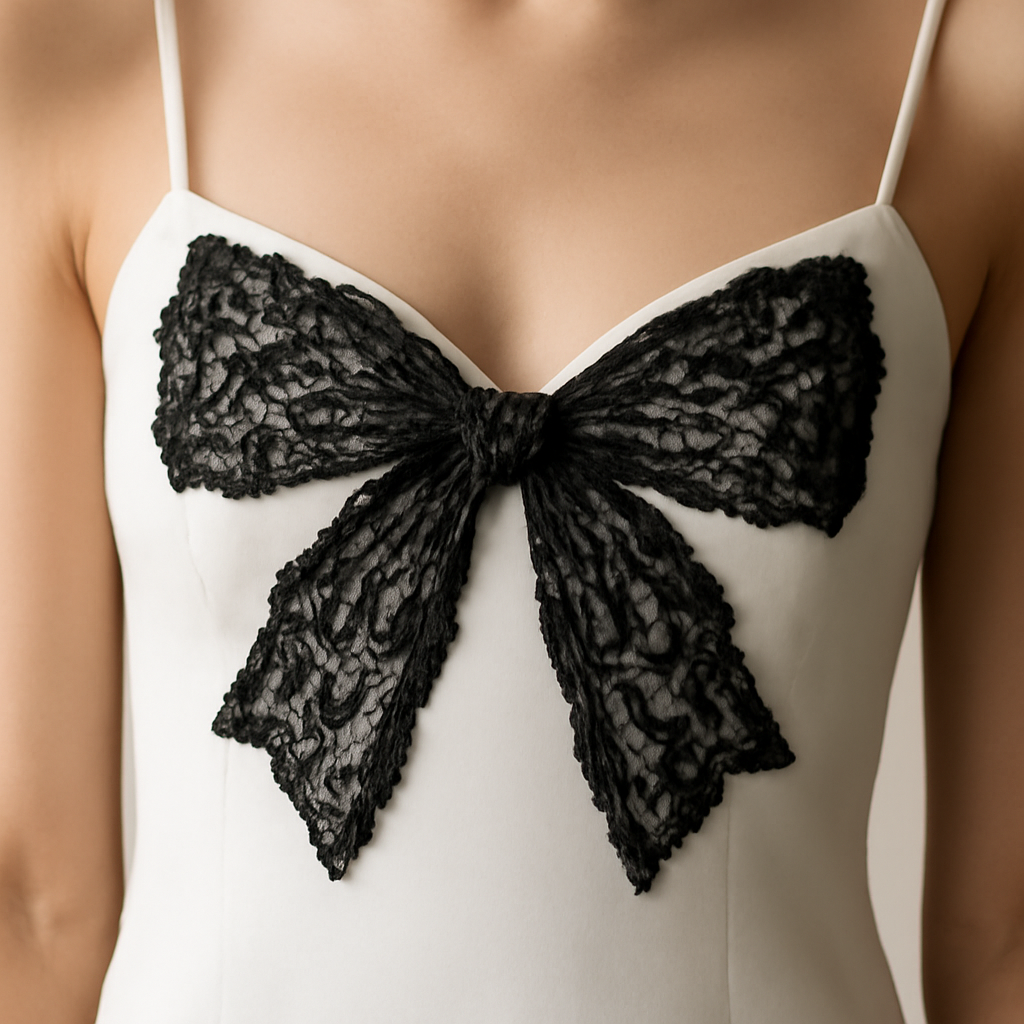
A crisp white cotton shirt, collar left open at the throat, has come back again this month on Carolina Herrera's runway — cut close through the shoulder, then let go below the waist into something closer to drapery than menswear. One season it arrives with a black lace bow pinned dead-center at the bodice, worn under a ballgown skirt. Another, it is remade in moiré with balloon sleeves, tucked into a belted, high-waisted trouser. A third time it becomes the skirt itself, in taffeta dyed cayenne or a hard, bright blue, worn with something almost casual on top. The shirt is never absent from a Herrera collection, and it is never quite the same shirt twice.
Carolina Herrera started that sentence herself in 1980, a Caracas-born socialite in her early forties who'd spent childhood afternoons watching her grandmother buy Balenciaga before Diana Vreeland, then running Vogue, told her flatly that she ought to be designing rather than just wearing the stuff. Wes Gordon has spent seven years continuing it, and by now his method looks less like habit than translation. Raised in Chicago and then Atlanta, he wasn't brought in from outside to shake the house up — he'd been Herrera's creative consultant since 2017, a year of studying her patterns before she handed him the title, and his own label before that had spent nearly a decade in New York's Financial District dressing women like Gwyneth Paltrow and January Jones in a register not far from hers to begin with. So when he took over in 2018, the job wasn't invention. It was closer to translation: take a sentence the house had been saying since 1980 and find a way to say it again this year without repeating himself, or her.
That approach reads more clearly against its opposite. In December, Chanel — a house eleven decades old, four creative directors deep — went the other way, hiring Matthieu Blazy, a Paris-born designer raised between Brussels and Charleroi, the first from entirely outside the family to lead the house since Karl Lagerfeld. The instruction he was given was close to the opposite of Gordon's: push, test, "we don't want to give the feeling that the brand is stuck." Chanel needed a stranger to make its old grammar sound alive again. Herrera never let hers go quiet enough to need one. The two solve the same problem — how a house keeps meaning something after the person who invented it stops designing it — from opposite directions, and both, this year, are being called successes. Continuity and disruption turn out to be two names for the same discipline: knowing exactly which parts of a sentence can change and which have to stay fixed for it to still be a sentence anyone recognizes.
What stays fixed at Herrera is narrower than a silhouette — it's an attitude toward the collar. Gordon's shirts are always buttoned as if the wearer meant to close them further and simply didn't get around to it. That half-finished quality is the actual inheritance, more than the fabric or the cut: a woman dressed like someone interrupted mid-decision, not someone who spent all morning arriving at the look. Herrera built her name on that exact appearance of ease, and Gordon's variations — the bow, the balloon sleeve, the taffeta skirt standing in for the shirt entirely — are really just seven years of testing how far the sentence can bend before the collar stops reading as unbothered and starts reading as styled.
This season's version tucks the shirt under a skirt so structured it could stand on its own, then leaves the top three buttons open anyway. The effect shouldn't work — armor above, ease below — and for a few seconds on the runway, watching the fabric decide which instruction to follow, it isn't clear that it does. Then the model turns, the collar falls open another half-inch, and the whole thing settles into looking like exactly what it is: a shirt still deciding, forty-five years in, how much of itself to give away.



